Category: Strongly Held Beliefs

  • Funny Stuff

    This week’s Road Trip Wednesday at YA Highway asks, Who is your favorite comedian or funny book and/or movie? I don’t follow comedy much, so I’m not sure I have a fave comedian. If I had to name one, it would be Jon Stewart. Funny movies–I don’t see a lot of them, period, and the ones I see tend not to be comedies. I liked Bridesmaids (which I saw on a flight back from The Netherlands), but I don’t usually like that kind of gross-out humor.

    Books, though, I can come up with three right off the top of my head. Two more recent offerings in YA, one from the ’60s that I originally read in high school.

    Newest first. Fellow Tu Books author Kimberly Pauley’s Cat Girl’s Day Off was a silly, goofy, fun, funny laugh-out-loud treat. I liked it so much, it was my RTW Best Book in April 2012.

    Second, John Green & David Levithan’s Will Grayson, Will Grayson was a gem. Back in the day (when I was an actual teen reading books about teens), a book like Will Grayson, Will Grayson would have been called a “coming of age” book. I love how the two main characters and excellent secondary characters (the two Wills and Tiny) are all so beautifully drawn. I disliked the second Will Grayson character almost immediately, but he had such a fantastic character arc, I loved him at the end.
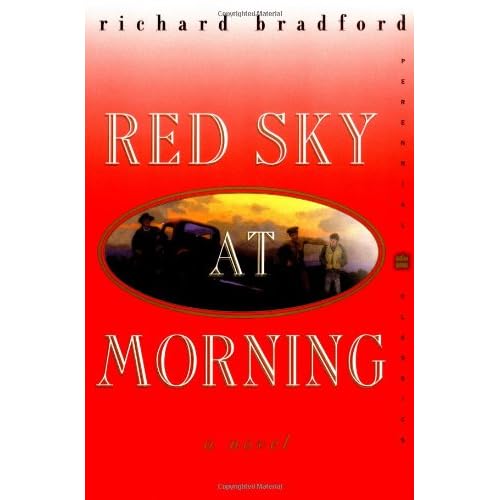
    Third, Richard Bradford’s Red Sky at Morning is an actual “coming of age” story that very much deserves to be read by today’s audience. Published in the mid-sixties, the story takes place during WWII. The main character is Josh Arnold, and his father is going away to war. Josh and his mother have to move from Mobile, Alabama to Corazon Sagrado, New Mexico. Red Sky at Morning is also a “fish out of water” story as Josh, used to city life in the South, has to adjust to a small town in the mountains of New Mexico where he’s in the minority (most of the town is Hispanic). This is one of those books that will have you roaring with laughter, then sobbing within a few pages. A wonderful book.

    How about you? Read any good, funny books?

  • Goals–Fear & Loathing

    Goal KittenThis week for Road Trip Wednesday, YA Highway asks, What are your goals for the new year–for reading, writing, or other? I gotta tell ya, this kind of question always terrifies me.

    It goes along with that equally frightening question, Where do you see yourself in five years? Luckily I’m not out there pounding the pavement looking for a job and so I don’t have to answer that one.

    The thing that’s so scary about goals is that I immediately fear I won’t be able to reach them. I’ll promise myself I’ll lose five pounds, and that bowl of ice cream will tempt me. I’ll declare I’ll read four books a month, and I’ll come up one short. It’s much easier to do things “unofficially,” that is, having the idea or notion or half-baked whatever that I might want to eat half as much ice cream next time I scoop up a bowl. And maybe I’ll count the number of books read without stating that this many reaches a goal.

    That’s not to say I can’t meet deadlines or finish tasks. I do that all the time. I have a few book deadlines in the upcoming year that I have to meet. But those aren’t really goals. To me, a goal might or might not happen, and let me tell you, these books have gotta happen. No choice there.

    So what is it about the word goal that makes me cringe, that makes me worry? What’s up with that, do you think?

    Well, whatever it is, let me put on my big girl panties and fess up to one goal I’d like to achieve. Here it is: I want to become more disciplined in my writing life. I’d like to accomplish that by resisting the allures and attractions of the Web and Internet when I should be writing. It is ever so much more entertaining to read blogs and tweets all day than it is to put words on a page.

    big-foot-wavingGulp. There, I said it. And I will work toward it, I promise. I will do my best to achieve that big, scary goal.

    How about you? What are your hopes for the new year?

  • The Shopping Gene

    If I say, let’s go shopping, and the destination is the local mall, or the outlet stores, or those cute little shops on Main Street, does that invitation fill you with dread or excited anticipation? Does the necessity of going in search of something you can’t do without seem like torture, or are you happy for the chance at the hunt?

    While I am not by any means a shopaholic, I do like shopping. I generally prefer it when there’s something in particular I’m looking for. For instance, I had a lot of fun shopping for dress shirts and ties for my husband’s Christmas gift. I get a great deal of satisfaction finding a shirt in the right size, the perfect color, and the tie that pulls it all together. It’s also nice when the price is right.

    JacketBut I am aware that there are others who just despise shopping. When the jacket we’d ordered from Amazon for my son didn’t fit right, nor was it warm enough, we decided to shop locally for another jacket before he returned to the East Coast. To say he dislikes shopping is putting it mildly. While I see it as an opportunity to search out exactly the right thing at the right price, his reaction is more along the lines of dread.

    But we truly lucked out. We headed for Eddie Bauer at the outlet stores. It just so happened they’d gotten in a couple of “East Coast” jackets, jackets that were rated for zero to 20 degrees. It was a mistaken delivery in chilly but still rather temperate Northern California. Because they knew the jackets were too warm for 99% of their shoppers, they were selling the two at a 50% discount.

    Woo-hoo for us. One of the jackets fit fine and was plenty warm. We added a few pairs of jeans to the pile and in very short order we’d completed our shopping goal. I felt triumphant and fulfilled. My son was just relieved.

    So how about you? Is shopping one of your favorite activities? Or would you rather chew dirt?

  • I Love You, You’re Perfect…Now I’m Gonna Revise You

    rewriting_265x265This week, with November and NaNoWriMo in the rear view mirror, YA Highway’s Road Trip Wednesday asks, How do you approach editing/revising?

    So, here’s the first most important thing about revising. You should write your draft knowing that you not only don’t have to get it perfect the first time through, you’re not expected to get it perfect. That’s one thing about NaNoWriMo that’s pretty great. The demand is so enormous (having to average close to 1700 words a day, every single day of November), you can’t possibly revise as you go. You just have to barrel ahead, getting the words down. But you have that freedom every time you write. You can always fix it later.

    Here’s the second most important thing–nothing that you’ve written is sacred. Nothing. Nothing. Every chapter, scene, paragraph, word, even character must be subservient to the story. If something doesn’t work, even if it worked at first, but in the course of revising is no longer relevant, that beautiful chapter, scene, paragraph, word, or character must go. And you must be ruthless in cutting out that dead weight.

    Here’s the third most important thing about revising. You must approach your revisions as if you were the editor rather than the writer of the book. You must go in there looking for trouble, not expecting a masterpiece. And you should never take it personally. Even the best manuscripts go wrong sometimes.

    Now that we’ve got those three basic musts down, here are a few other things I’ve learned over the course of writing and revising 20+ books.

    1. Give it a rest. After you’ve finished your manuscript, give yourself some time so you can return to it with a fresher eye. How much time? I personally don’t like to go longer than a week, and it’s usually just a few days. But you might need a couple weeks or even a month.
    2. Give it a read and think story as you go. Are the story questions answered? Are all the setups paid off? Is there extraneous material that doesn’t move the story forward? Are there characters who don’t pull their weight? This is where your major revising will be happening, where your bigger problems are solved.
    3. Give it another read and look at characters and details. Are your characters’ actions & dialogue consistent for them? Have you introduced word or phrasing repetitions in the course of your first big revision? Ditto for typos?
    4. Give it a final read. Are there any parts that just don’t flow? Awkward phrasing, expository dialogue, settings that are either overly detailed or not detailed enough? Anything confusing that you think a reader might stumble over or have a problem following?
    5. Let someone else give it a read. If you have a critique group or a beta reader, preferably someone who has never heard about the story, ask them to read it. It has to be someone whose opinion you completely respect and trust. And you have to be open-minded about their feedback.
    6. As needed, give the manuscript one last revision based on reader feedback.

    So is it a hard and fast rule that you must give your book three (and only three, no more, no less) readthroughs? No. But is it necessary to pay attention to all of the above elements while revising? I’d say yeah. If you can do that with one pass through the book, that’s great. As long as you’re reading with an editors eye, and are brutally honest with yourself about what’s working and what’s not.

    Happy revising!

  • Lee Child is a Pantser (and So Can You!)

    Lee Child 11-29-12The other night, I had the fortunate opportunity to attend a talk by mega bestselling thriller author Lee Child. He is funny, charming, and down-to-earth, not at all the prima donna stereotype of an internationally successful writer. Even in the face of reader controversy (and these were some passionate readers in the audience of about 650) Child stood his ground, explaining why in the upcoming film, Jack Reacher, his main character, standing six-foot-five and weighing in at 250 pounds, will be played by Tom Cruise, who stands a tad shorter and is a wee bit lighter weight. (Short answer–there aren’t too many actors who can “open” a movie and none of the ones who can are of Jack Reacher’s physical stature).

    One of the best parts of the talk was when Child described his working style as a writer. He’s not a morning person. He’s up by around 10:30am and doesn’t start working until about noon. He tends to write for 4-5 hours, then the well is pretty much dry. (Side note: My husband was there, and I was glad he heard this. Because my experience is similar in that I have a limit after which I just have to walk away from the book).

    It takes Child about 90 days like that to finish a book. I’m going to guess his books are at least 120,000 words long, which means he’s writing close to 1500 words/day. That’s a hard pace to keep up. Could be even more words if that 90 days counts editing time.

    One tidbit I found especially interesting about Child’s method is that he does not outline his books. At all. He wants to have the same experience as an author (gee, I wonder what’s going to happen next?) as a reader does. This is utterly amazing. He writes big, complex books, and I’ve never seen anything in them that seems out of place or extraneous. To write all that off the cuff is awe-inspiring.

    http://leechild.com/wp-content/uploads/2012/09/A-Wanted-Man-News-320-FR.pngAfter the talk, I had an even more delightful opportunity–to exchange a few words with Child. I’d bought two of his books at the event, the newest Reacher novel, A Wanted Man, which came pre-signed, and a backstory book, The Affair, which wasn’t signed. So I stood in line with hundreds of other equally excited fans wondering if I would just stand there squeeing like a fangirl, or if I would be able to say something coherent.

    I’m glad to say I was mostly coherent. I said to him, “So, you’re a pantser,” and he confessed he was. I then told him that I was a total plotter, my very unsubtle way of announcing that I was also a writer. He asked my name, asked me what I wrote, I told him young adult, and squeezed in that I’d just sold two mysteries to Angry Robot’s new Exhibit A imprint. His assistant (publicist?) said, “Oh, we’ve heard really good things about them,” and I was totally chuffed. I moved on, not wanting to monopolize his time any more than I had.

    Very fab night. But here’s the grand revelation I experienced. Yes, I’m a plotter before I start writing. I’ve got a 21-page synopsis of Revolution, the third Tankborn book. But when I’m writing, an entirely different process takes over. I almost never look at that synopsis. I get brilliant inspirations. I have someone come into a room and have no idea why they’re there, and they’re looking for something, and I have no clue why that thing even matters. But then something clicks, that pantsing moment, and I realize this seemingly mundane scene I’ve written is a set up for something wonderful later on down the line. Something very important to the story.

    So, by God, I am a pantser. And I’m glad to tell the world.