Category: The Writing Life

  • I Fib Not, Fibonacci

    I can be a real glutton for punishment. For instance, in college, I majored in math with a physics minor. Then I went on to earn an MS in computer science. I avoided continuing on to a PhD because it alarmed me how much gray hair the doctoral candidates had.

    All along, I also indulged my writing obsession. I wrote plenty of science fiction short stories (my first baby steps along the path to writing my YA novel, TANKBORN). I also enjoyed writing sonnets (yes, really). My preferred form was Shakespearean, fourteen lines, iambic pentameter, a-b-a-b, c-d-c-d, e-f-e-f, g-g rhyme scheme.

    Then I discovered acrostic sonnets. Azimov’s Science Fiction magazine had a contest for best acrostic sonnet and although I’d missed the deadline for entry, I got hooked on writing the devilish things.

    So, what’s an acrostic sonnet? Start with a 14-letter word, phrase, proper name, then use the letters of the word/phrase/name to start each line of the sonnet. The sonnet itself should have something to do with the word/phrase/name.

    So, what did I write about? The nerdy stuff I was studying in school. QUEUEING THEORY and QUANTUM PHYSICS. Also a couple of Trek-related tries.

    I bring this up because I learned over the weekend from fellow writer Greg Pincus about Fibonacci poems. They’re based on Fibonacci numbers, which start with 0 & 1, then proceed from there with subsequent numbers equal to the sum of the two previous. Therefore, after 0 & 1 come 1 (=0+1), 2 (=1+1), 3 (=1+2), 5 (=2+3), 8(=3+5), 13(=5+8), 21(=8+13), etc. The poems are written using 1 syllable in the first line, 1 in the second, two in the third, three in the fourth line, five in the sixth line and on and on. I guess if the poem goes on long enough, you’ll get some pretty long lines.

    So, I could have just written some Fibonacci poems, right? I’ve written plenty of decent, self-respecting poetry. This would be a fun, new form.

    But no-o-o. I had to notice that “Fibonacci Poems” has 14 letters. The exact number needed for an acrostic sonnet.

    I was doomed. My obsession took over.

    So, here it is. My newest acrostic sonnet. My apologies to Greg and fans of Fibonacci poetry everywhere.

    First, I should say I studied math in school.
    In fact, I’m what you’d likely call a nerd
    Because I think that calculus is cool.
    Oh, I can integrate x to the 3rd.
    Now, though, I write. Equations have become
    A sentence on the page. And x and y
    Combine to make a word, and not a sum,
    Creating stories, no more graphing lines.
    I’ve heard there is a certain kind of verse
    Prepared by counting syllables from one
    One, two, then three, then five…it’s somewhat terse,
    Embracing sequences and number fun.
    Most people may not like to do their math,
    So poetry can trick them down that path.

  • We Have a Cover

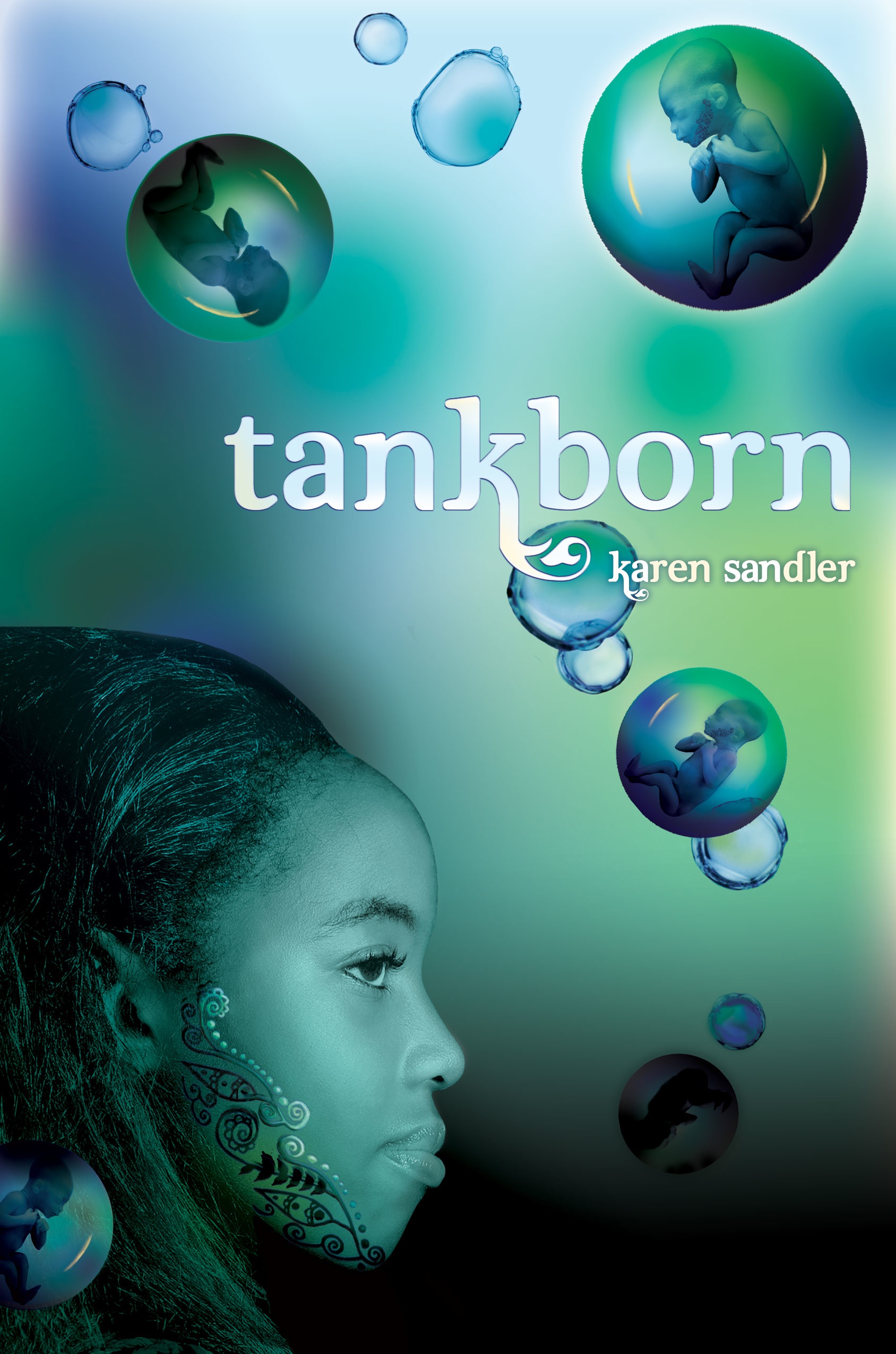
    Just a short post to announce that I can now reveal the cover art for TANKBORN, my dystopian young adult novel that will be coming out in September 2011 from Lee & Low’s new YA/MG imprint, Tu Books. Lee & Low announced the three launch books on their Open Books blog. You can check out the cover there, or hop on over to my website (where this blog also appears) for a slightly larger version. The blurb for the book is on my booklist page.

    I’m so excited about my cover. I think it looks great. There’s one kind of cool-creepy aspect to the image. If you look closely at it (you’ll have to examine the larger one that’s on my site) you’ll see the floating babies have tattoos on their cheeks that match the one on the heroine, Kayla’s, face. You’ll have to read the book to find out what that’s all about.

    So please check it out and tell me what you think!

  • Website Adventures

    I recently launched a brand-new version of my site, www.karensandler.net. As an author who’s undergone a genre change from adult romance to young adult fiction, I needed a new look for my site that would better represent who I now am as an author. Since my first YA, Tankborn, is dystopian science fiction, I wanted some really cool SF/fantasy art for my site.

    I have little artistic talent myself (hey, I’m a writer, I use 1000 words, not a picture), so I knew I wasn’t going to be the one to draw the art for my site. Not entirely sure what I wanted, I perused several stock art sites. But I couldn’t find anything that looked right. I next checked out the websites of other YA authors, to see what I liked and didn’t like. Scott Westerfeld‘s site, for instance, is very cool and along the lines of what I was looking for. I tried to figure out his artist’s name, but couldn’t find it.

    So I turned to Google, using search terms such as “fantasy art” and “science fiction art” in hopes of stumbling across an artist I liked. Not much luck there. I found tons of artwork, much of it quite nice, but it either didn’t match that amorphous image in my head, or if I did fall in love with their art, they were big, big names, and there was no way they would be willing to do my little old website.

    I put out calls on a couple of my writer lists for a fantasy/SF artist and finally hit paydirt. An author e-mailed me with the name and website of a new artist, Matthew Leese. I checked out the portfolio Matt had posted on his site and discovered that his style matched beautifully with my still somewhat cloudy vision.

    After some back and forth, Matt and I signed a contract. I pointed out the sites I liked as examples. I told him what I was pretty certain of: that I wanted a cool masthead across the top, reminiscent of Scott Westerfeld’s (but different :-)), I wanted a DNA strand in which the links would be incorporated, and I wanted to use the GEN tattoo design on the page. (GEN=Genetically Engineered Non-human).

    He began by drawing me some rough sketches that included possible fonts:

    Much back and forth ensued during which we considered the font suggestions. I voiced my extreme dislike of mixed-case fonts (for example in the first font, the “n” is lower-case when all the other letters are upper-case). Matt said if I found a font I otherwise liked, he’d fix the mixed-case problem.

    There was also much discussion about what the GEN tattoos should look like. There was a parallel discussion with Stacy Whitman, my editor at Lee and Low,  since the tattoo would also be featured on Tankborn‘s cover. There was no way to make the website and cover versions identical since Matt didn’t have the cover to refer to. But I wanted a similar design. Stacy and I settled on henna-type designs and I relayed that to Matt. He sent his next rough sketch:

    Here is where the fogginess of my vision caused a wee bit of trouble. You’ll notice the DNA devolves into a sort of creature at the bottom of the page. That’s because I had this cockamamie notion that I would try to incorporate elements from another book series I’m working on, one that isn’t finished, let alone published. Bad idea. But Matt dutifully did what I’d asked. It took me several iterations before I finally pulled the plug on the hybrid site concept.

    After zeroing in on the desired font and font color, Matt sent me his next sketches, this time in color:

    Now we were getting closer to the final design and I was starting to see my vision made real. The DNA is also closer to its final version in the second drawing. I’d been pulling in my husband all along (he was going to be my webmaster, the one responsible for actually programming everything). His concern with these sketches was that having the links above my name might make them harder to see (since they’d have the buildings as a backdrop). Also, they’d cover up some nice artwork. I agreed, so Matt’s next sketch incorporated that change:

    In addition to finishing the Hindu-style temple, Matt filled in some henna designs on either side. It’s not the final representation of the GEN tattoo, but it’s getting closer. Also, the background on either side of the temple still needs to be finished. But it’s looking very cool.

    It took a half-dozen more iterations back and forth, minor tweaks and clarification of misunderstandings. Turns out I’m not only not much of an artist, I’m pretty poor at communicating an artistic concept. Matt would draw exactly what I’d asked for, then I’d realize when I saw it that what I’d asked him to do was not at all what I wanted. My apologies, Matt.

    In the end, I have a gorgeous website. I’m thrilled with the final result. I’d love to have you visit and leave a comment letting me know what you think.

  • Patience & Dinosaurs

    Waiting for stuff has always been a challenge for me. I want it now, whether it’s the cover art for my upcoming book, TANKBORN (which my editor has teased me with), or the new graphics for my website update, or the ARC (Advance Reader Copy) for TANKBORN going out to reviewers. Getting those first reviews is kind of a love/hate thing, but I’m still looking forward to it. Then there’s the release date itself, for TANKBORN, WOLF MARK, and GALAXY GAMES, Tu Books’s launch books. Will that day ever get here? Surely the calendar is stretching and Fall 2011 will arrive a few months later than usual.

    I’ve published 17 books. You’d think I’d be used to waiting for stuff like this. But I’m not. After an author has finished writing a book, it almost always take months and months for the book to come out. In the case of TANKBORN, it will be nearly a year between when I sold it and when it shows up in the bookstores (or on Amazon). Longer than I had to wait for my granddaughter, and that delay was torture.

    Sometimes I wish I could hop into a time machine and zap myself into the future. Watch my book flying off the shelf, becoming a world-wide bestseller. Hey, if I’m going to imagine a time machine, I might as well imagine a fabulous future.

    Eodromaeus Illustration by Todd Marshall

    Speaking of time machines (or rather what I might use them for), here’s my cool science story of the day. Just announced, the discovery of Eodromaeus (dawn runner), a meat-eater the size of a 7-year-old kid that weighs about what a house cat does. What’s interesting is that it looks a lot like another dino called Eoraptor, which is a plant-eater.

    So imagine climbing into that time machine and traveling back 230 million years ago. You confront this kinda cute waist-high fella somewhere in what is now Argentina. Is it Eoraptor or Eodromaeus? You pull up some grass to offer to the little guy to eat. Will he nibble that grass out of your hand? Or will he chomp your hand right off?

    Heh. I guess it would be better to stay out of the time machine.

  • Fear No Science

    I am a self-confessed science geek. I had great fun in my high school science classes and devoured science fiction short stories and novels. In college, I found physics and chemistry pretty fascinating. I always zero in on the science articles on the web or in the newspaper (yes, I still read the newspaper). No big surprise that I’m thrilled that my own science fiction book, TANKBORN, will be published in the fall.

    No big surprise either that science doesn’t scare me. Yeah, people have done some pretty frightening things with science. Weapons of war come to mind. But the benefits of scientific discoveries so outweighs the negatives (medical advances, computers, cell phones, the Internet), it doesn’t make sense to me to fear it. You might not want to dissect that frog in biology class (yeah, kind of ick), but despite the gross factor, it’s kind of cool seeing what’s inside a frog.

    So what nifty science have I learned recently? I learned that babies make a phenomenal number of synaptic connections in their brains. They start with a clean slate, then as they bop around, discovering one new thing after another, they build those connections until they’re a big tangle. That’s pretty intriguing right there, but then when children grow, they start losing some of those connections. By their teens, they have far fewer than they did as a baby. Why? One explanation is that we start to “specialize,” that is, we focus more on certain things of interest. Our preferences and personalities develop, and we lose the extraneous stuff.

    Synaptic Exuberence at“ Birth, at 6, and at 14, Public Library Association

    As an author, my next question is, how could I use this in a story?

    What if scientists developed a virus that kept babies from losing all those thousands of connections they’d formed? What if the virus escapes the lab and sweeps the world? It doesn’t affect grown-ups, but every infected baby (say, under the age of 1) no longer loses any connections formed in their brain.  The scientists’ goal was to improve the human thinking process, that with all the extra connections, we’d be able to do a ton more things than the average person. But instead, what if we’re so swamped with knowledge and experience that we’re frozen, incapable of doing anything? Have the scientists created a race of overachievers, or millions who can’t function because of brain overload?

    Okay, I’ve ventured into scary science here. But even still, it was fun to learn about baby brain connections (especially since I’m a new grandma) and neat to brainstorm a story idea based on it. That’s one thing I like about science as an author–it activates my imagination.

    How about you? Is science scary or fascinating? Did you sleep through high school biology class or fall in love with science in ninth grade? Drop me a comment and let me know.