Tag: rebellion

  • A Visit to Oaxaca, Mexico

    My husband and I had a marvelous trip to Oaxaca, which is nearly the southernmost state in Mexico (only Chiapas stretches farther south). We were there for a week with five days of touring and a couple days on our own. The scenery is stark (it’s very desert-like), but the city of Oaxaca and the Oaxaqueños who live there are wonderful.

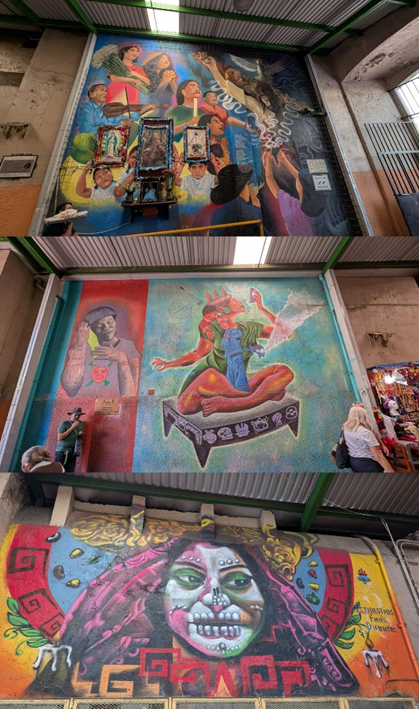
    I love murals and so many of the ones I saw were brilliant. These were indoors in a shopping area.
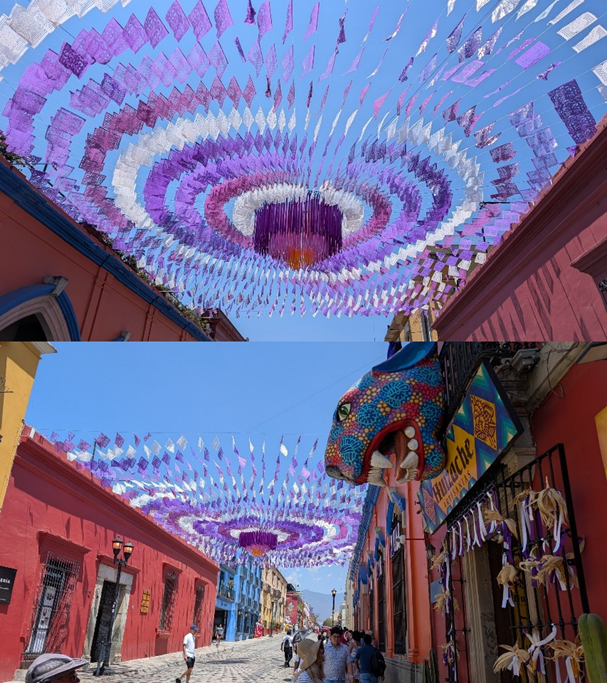
    While we were there, the state of Oaxaca celebrated Dia de la Samaritana, or Good Samaritan’s Day, which falls on the fourth Friday of Lent. In addition to the decorations everywhere, people gave out “agua fresca” (fresh water), which is water flavored with fresh fruits, herbs, flowers and other ingredients. We had horchata that day. The “Papel Picado” (the paper decorations) were so lovely.
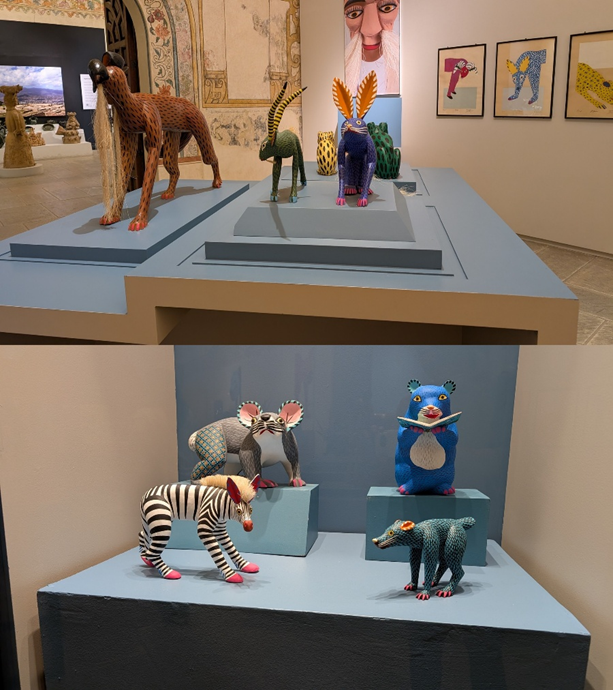
    Another part of Oaxacan culture that I absolutely fell in love with were the alebrijes (ah-lay-bree-hiss). These are carved figurines made of wood that are painted bright colors in fantastical designs. The ones below are from a museum exhibit of the work of Manuel Jiménez. He popularized the wooden alebrijes.
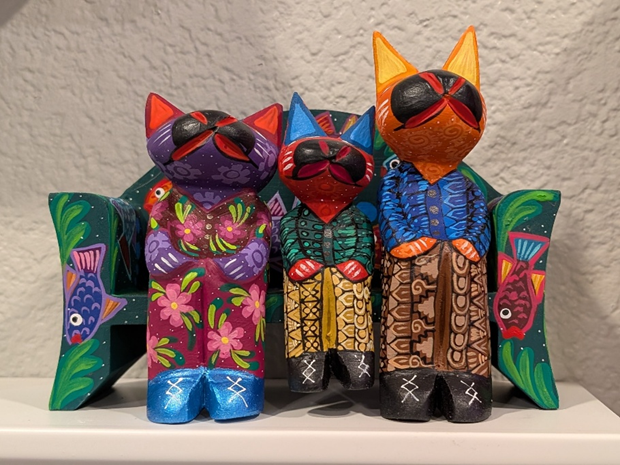
    I bought way too many alebrijes at the artisan markets. Some were for family, but most were just for me. This one with the cat family sitting on a bench is my favorite. <heart emoji>
    I have a ton more pictures (like of the wedding parade we became impromptu members of), but it would take many more newsletters to show them off. I don’t want to put you all to sleep, lol. Suffice it to say, it was a fabulous trip.


    Some of you reading this might remember my science fiction trilogy, Tankborn, Awakening, and Rebellion. I now have a new series planned that’s a spin-off of the world of the Tankborn books. The first book, Mishalla’s Courage, is published and the second book, Pheno’s Treachery, will be available later this year.
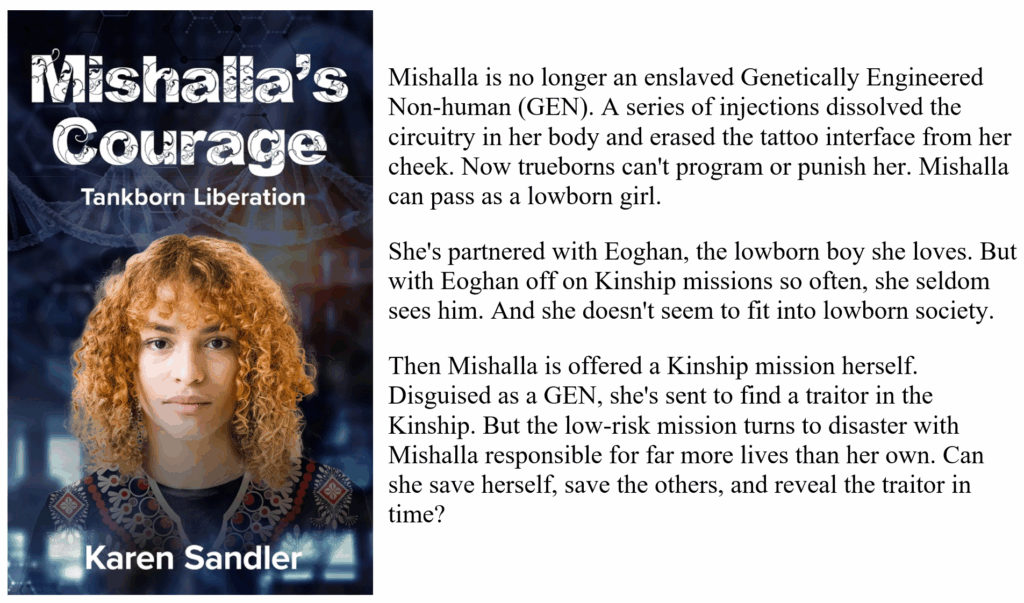
    Click here to order Mishalla’s Courage as an eBook for the device of your choice. It’s also available at that link as an audio book and as a print book edition with color illustrations.

    I’m planning five more novellas, all featuring new characters introduced in Mishalla’s Courage. So you’ll want to get started now with the first book.

  • When Life Turns on a Dime

    SticksSometimes life imitates fiction. For instance, you’re tooling along, everything as usual, expecting to grill a couple burgers for dinner, then kick back and watch the ball game And out of the blue, something happens that throws you a curve, all your mundane expectations scattered like pick-up sticks (click here if you’re too young to remember pick-up sticks)

    IV RackI’ve had that life-off-the-tracks experience a number of times, most recently a week or so ago when a family member was unexpectedly hospitalized (he’s fine).

    TOSHIBA Exif JPEG
    The ill-fated horse I never bought.

    There was another shake up a couple years ago. I broke my ankle moments before I’d planned to leave to check out a horse I was thinking of buying. That break not only stopped me from buying that horse, it kept me from riding for several weeks.


    Wrecked Car1Thirty-five years ago while driving to work, someone turned left directly in front of me. The collision totaled my car and when I slammed on the brake pedal, I fractured my foot (same one I later broke the ankle of). That particular accident led indirectly to me meeting my husband of three-plus decades, so it wasn’t all bad. 😉 But I ended up in the hospital rather than work that day.

    When you’re writing a story, you’ll want send your characters into a similar life-off-the-tracks situations right from the beginning. They can start out in an everyday, humdrum experience, but within pages, everything has to change for them. Whether they’re fired from their job or barely escape being flattened by a piano, an inciting incident had better yank them free of their moorings. And their travails have to continue, building in magnitude to keep your reader reading.

    I wouldn’t wish a car accident or a broken ankle on anyone. But when it comes to my fictional characters, sometimes a trip to the hospital is just what the doctor ordered. 🙂


  • When Your Characters Come Out to You

    3 CoversI recently guest blogged at GayYA.org and wanted to share. In the post, “Are They LGBTQIA? Let Your Characters Tell You,” I talk about how I discovered the sexual orientation of characters in my Tankborn Trilogy as I wrote the books and got to know the characters better.

    You can check out the Tankborn Trilogy at Lee and Low’s website. You can also find TANKBORN, AWAKENING, and REBELLION on Amazon.

  • Near Death, Divine Providence, and Mining the Past

    Ford Fairlane 1964
    photo credit: DSC03226 via photopin (license)

    When I was 12 years old, I nearly died.

    At the time, my two older sisters and I lived with our mom in the San Bernardino Mountains, about 2 hours east of Los Angeles. It was Easter Sunday, and we’d gone to visit my grandmother in L.A. for Spring Break. Grandma and Papa had dropped us off at the bus station in downtown L.A., and Mom came to pick us up at the bus depot in San Bernardino.

    Mom 1970sMy mom, God love her, was a terrible driver. She was a lead-foot, not only on the gas, but on the brake as well. She drove “down the hill” (from nearly mile-high Blue Jay to San Berdoo’s thousand foot elevation) screaming around those mountain curves, most likely with her foot on the brake most of the way.

    She picked us up at the bus depot, me and my sisters still wearing our Easter dresses. We tucked our luggage and our basket of Easter eggs in the trunk, then Mom headed back up the hill. My older sister Debbie sat in the middle of the car’s bench front seat next to Mom, and I sat next to Debbie by the door. Our oldest sister, Linda, sat behind me in the back seat.

    Mom might have used less brake going up, but the brake drum nevertheless got hotter and hotter until about halfway up the hill, the heat actually blew a tire. We pulled into a nice, level turnout and a kind passerby changed the tire for us. The gentleman told my mom she better let the brakes cool before continuing on home. We sat around for what Mom thought was long enough, then pulled out again.

    Stier Sisters Late 50s
    Me, Debbie, & Linda celebrating Linda’s birthday with a Barbie doll cake.

    I don’t remember if there was a smell, or Mom could feel the heat through the brake pedal. In any case, she decided to pull over into another turnout and let the brakes cool again.

    Except this turnout was sloped. The car started rolling backwards. The brakes were well and truly fried and no amount of stomping on Mom’s part would get that car to stop. The car just kept rolling toward the edge where the mountainside plunged down a couple hundred feet of steep embankment.

    For some reason, Mom didn’t think to try the emergency brake. I suppose it might not have worked anyway. She was struggling to put the car into park. When that didn’t work, she jumped out and tried to stop the car with her body. The car knocked her down and partially rolled over her. Not with its full weight because at that point, the rear of the car was already over the edge, so the front end was partially off the ground.

    While Mom was fighting to stop the car, Debbie had gotten the passenger side door open and was yelling at me to get out. I remember sitting sideways, my feet hanging out of the car, watching the pavement roll by under my feet. But I was frozen. Debbie couldn’t get me to budge. All the while, Linda kept yelling from the back seat, “I can’t open the door! I can’t open the door!”

    We were all about to die. And then a miracle happened.

    The car stopped. Linda got her door open, I finally scrambled out of the car with Debbie close on my heels. When we turned back to the car, we realized it had stopped with one front tire hooked to the berm that edged the turnout. That berm wasn’t even a foot high.

    Mom was banged up but nothing was broken or needed stitches. We three girls were perfectly fine. The car was towed out of its predicament, and it went on to suffer through more of my mom’s abuse. The Easter eggs ended up rotting in the trunk because we all forgot they were in there, a fact that we girls chortled over for years to come.

    Yeah. A miracle. That my mom wasn’t hurt more badly. That we girls didn’t flip right over the edge, none of us seat-belted into that pre-airbag car. That Debbie and I didn’t bail, and the car didn’t flip with Linda trapped inside. All those possibilities make me shudder now.

    Oddly enough, as dramatic as this experience was, I’ve never used it in a book. I’ve probably used the fear, the panic, the horror of it without consciously realizing where I might be pulling it from. It became a story that we all found hysterically funny because it did have a happy ending.

    In this case, reality was much better than the what-ifs. Thanks to God and miracles.

  • Innate Identity vs. Imagining the “Other”

    Rebellion Final Cover medWith all three books of the Tankborn trilogy completed and released into the wild, I’m doing as a writer does and working on my next project. Not to give too much away, but it’s a dark fantasy YA with a multi-cultural cast. No elves/orcs/wizards, but my own invented world. I’m on solid ground with my world-building, because it’s not based on anything except my own fertile imagination.

    But what about creating that multi-cultural cast, or more importantly, my main character? She’s Alejandra, a 16-year-old, 2nd generation Mexican-American girl who’s Catholic and lives in Reno, Nevada. She and her mom aren’t below the poverty line by any means, but they struggle a bit financially. She’s not a super-genius, but smart enough to get a scholarship if she works hard.

    Some of the cultural/identity elements of the character:

    • Mexican American
    • Catholic
    • Speaks a little Spanish (but not enough to carry on a conversation with her abuelita)
    • Lives in/grew up in Reno
    • Her family is little lower on the socio-economic scale
    • Very close to her mom
    • Hard worker
    • Not one of the popular kids

    Some of my personal cultural/identity elements

    • Russian-Austrian-Italian-German-American
    • Catholic raised, Jewish heritage
    • Speak quite a bit of Spanish (I could carry on quite a credible conversation with Alejandra’s abuelita)
    • Grew up in Southern California/live in NorCal
    • Have relatives in Reno & have visited there often
    • My family was middle-class, but we went through some rough financial difficulties
    • I was very close to my mom
    • I was a very hard worker in school
    • Most definitely not one of the popular kids

    Based on who I am, how well can I get into this character’s head? How authentically can I write her identity, her culture?

    It might seem like I’ve got it covered since there’s quite a lot of overlap in our life experience. But there’s a very key area missing–she grew up Mexican-American, and I grew up as a white American.

    People are people, you might say. We have more in common than we have differences. Absolutely. But if I want to write an authentic character, one with a different core identity than mine, who grew up immersed in a world different than mine, I can only imagine so much. And it’s possible that what I “imagine” about the character will come from my own ingrained stereotypes that will worm their way into my writing.

    Rosary-sSo what do I not have to imagine? What have I lived? I’ve lived the Catholic upbringing. Catholicism is so rooted inside me that to this day I can’t walk inside the church without reaching for the holy water to dip and make the sign of the cross. Even though I haven’t attended Mass in years, I immediately feel comfortable inside a Catholic church, like I’m home.

    By the same token, I often feel out of place during services at other Christian churches. And although I am Jewish by heritage from both sides of my family and am married to a Jewish man, I’m a complete fish out of water in a synagogue. I don’t know the prayers, in either Hebrew or English. I don’t know the songs. Judaism wasn’t part of my upbringing, so it didn’t get into my DNA like Catholicism did.

    I know what it’s like to be the unpopular outsider as a teenager. After all these years, that pain still lingers. I know what it’s like to work hard in school. I lived through difficult financial times when I was a kid, where my parents’ worries filled me with anxiety. I know what it’s like to be female, to sometimes be slighted because of my gender, and to sometimes fear men.

    But despite all that Spanish I learned over the years, despite living with many Hispanic neighbors in L.A., do I know what it means to grow up Mexican-American? No. Not in any gut way. I’m white, and I lived the white experience, with all its privilege and dominance, during a time when racism was far more accepted. I’ve experienced subtle (and sometimes not so subtle) bigotry and trivialization because of my gender. But it’s a white face I present to the world, and the world has treated me accordingly because of it.

    So how do I authentically write Alejandra? To some extent, I use my imagination, but in the end, I need some expert input. A friend has been giving me advice about the Spanish that is sprinkled throughout the book. And before the book ever sees the light of day, I intend to find a Mexican-American beta reader to vet my cultural references and make sure I haven’t let stereotypes creep in.

    Could I just decide to write only white characters in my books? I could. But I choose not to. And with that commitment to write diverse, comes the responsibility to make my absolute best effort to do it right.