Tag: young adult

  • A Visit to Oaxaca, Mexico

    My husband and I had a marvelous trip to Oaxaca, which is nearly the southernmost state in Mexico (only Chiapas stretches farther south). We were there for a week with five days of touring and a couple days on our own. The scenery is stark (it’s very desert-like), but the city of Oaxaca and the Oaxaqueños who live there are wonderful.

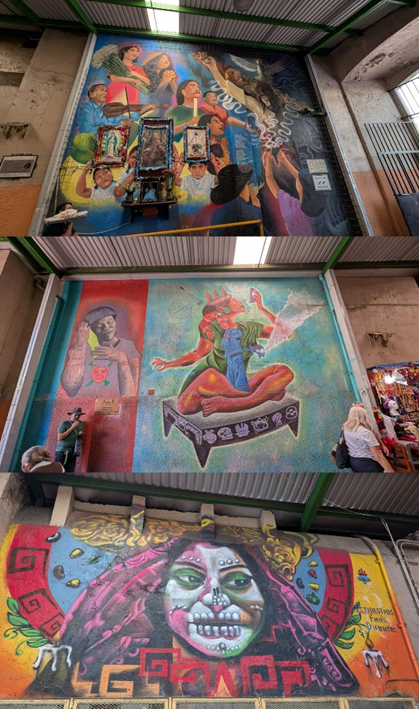
    I love murals and so many of the ones I saw were brilliant. These were indoors in a shopping area.

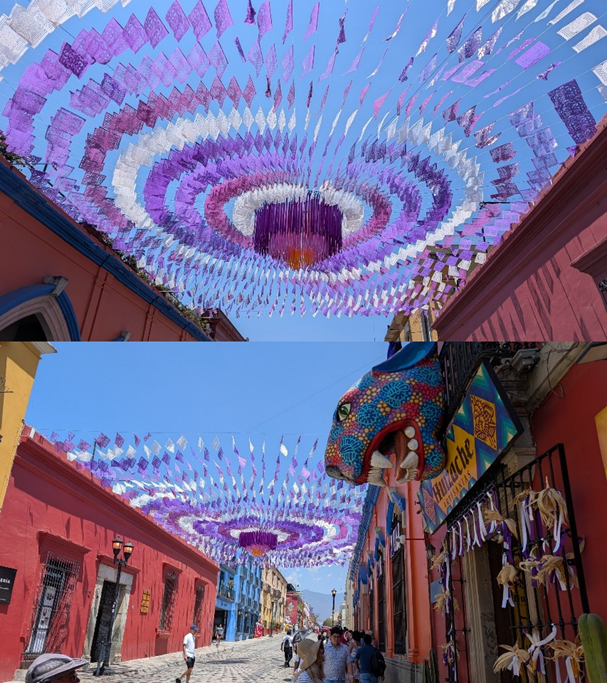
    While we were there, the state of Oaxaca celebrated Dia de la Samaritana, or Good Samaritan’s Day, which falls on the fourth Friday of Lent. In addition to the decorations everywhere, people gave out “agua fresca” (fresh water), which is water flavored with fresh fruits, herbs, flowers and other ingredients. We had horchata that day. The “Papel Picado” (the paper decorations) were so lovely.

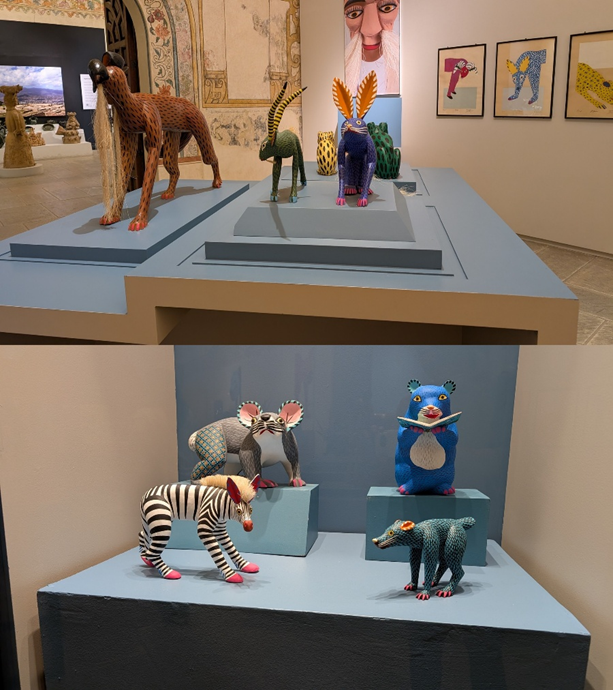
    Another part of Oaxacan culture that I absolutely fell in love with were the alebrijes (ah-lay-bree-hiss). These are carved figurines made of wood that are painted bright colors in fantastical designs. The ones below are from a museum exhibit of the work of Manuel Jiménez. He popularized the wooden alebrijes.

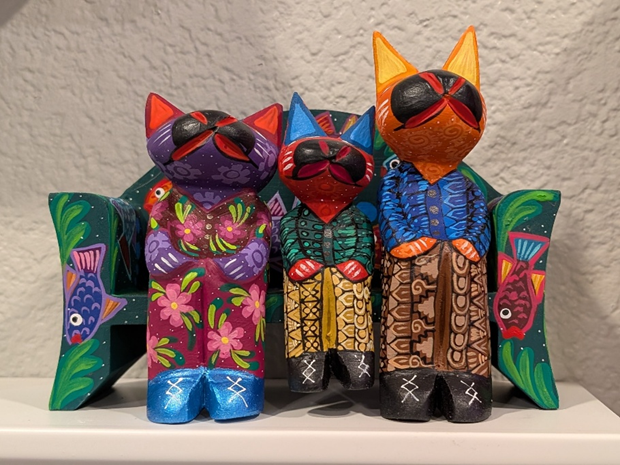
    I bought way too many alebrijes at the artisan markets. Some were for family, but most were just for me. This one with the cat family sitting on a bench is my favorite. <heart emoji>

    I have a ton more pictures (like of the wedding parade we became impromptu members of), but it would take many more newsletters to show them off. I don’t want to put you all to sleep, lol. Suffice it to say, it was a fabulous trip.


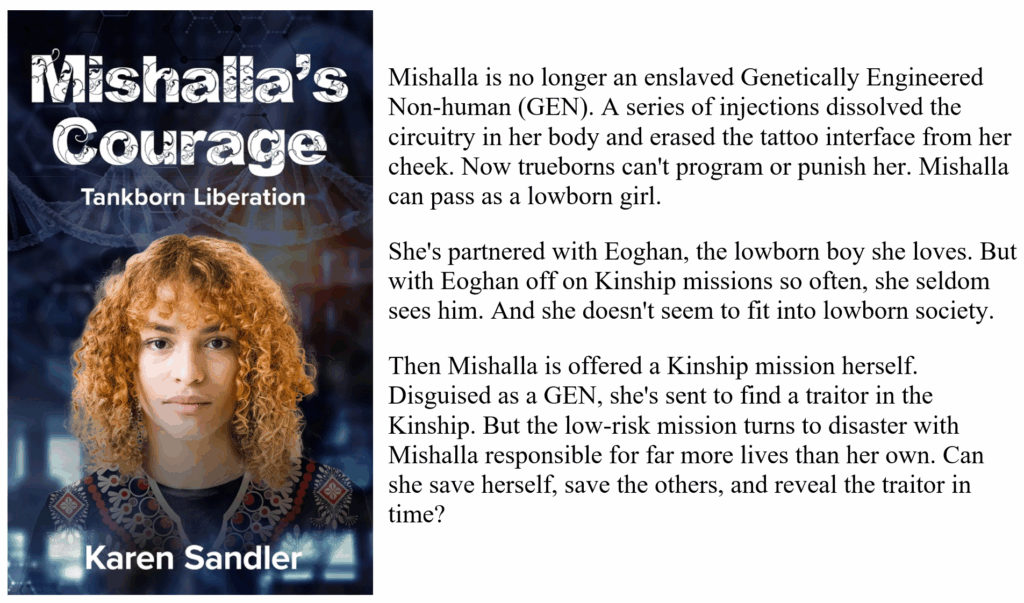
    Some of you reading this might remember my science fiction trilogy, Tankborn, Awakening, and Rebellion. I now have a new series planned that’s a spin-off of the world of the Tankborn books. The first book, Mishalla’s Courage, is published and the second book, Pheno’s Treachery, will be available later this year.

    Click here to order Mishalla’s Courage as an eBook for the device of your choice. It’s also available at that link as an audio book and as a print book edition with color illustrations.

    I’m planning five more novellas, all featuring new characters introduced in Mishalla’s Courage. So you’ll want to get started now with the first book.

  • Horse Trading, and Is Your Writing Really Ready?

    Gal canterBack in July, I blogged about how I was shopping for a new horse. I compared the process to figuring out which of the multitude of writing projects you might want to work on next. Then a few weeks later, I whined about my broken ankle and how difficult it is to wait–for an ankle to heal or for a writing career to get up and running.

    Well, my ankle is now ready for prime time (or horseback riding), but my search for a new riding partner has thus far not borne fruit. It’s not for lack of trying. It turns out to be harder than I thought to find a horse in my price range with the kind of training I’m looking for. To find one that’s not too young and not too old. To find one that’s been actually ridden and worked recently rather than hanging around getting fat out in a pasture.

    PEC 5-22-04 Indy Trot flipSo far, I’ve seriously considered more than a dozen horses. Sometimes I never even went to ride them because my trainer and I looked at video and saw they wouldn’t work for me. Others we rejected because the owners refused to send us recent video. If horse is a couple hours drive away, I want to see video first. I’d hate to drive all that way to see a horse and have it turn out be a waste of time, time I could have saved if I’d seen the way the horse moves.

    While there were a few I’ve gone to look at which were nice, but I just didn’t click with, there have also been several with peculiar stories:

    •    There was the 8-year-old that I’d thought was trained, but had barely had a few months under saddle
    •    There was the 11-year-old that hadn’t been ridden in four years. I wouldn’t have even visited this horse, except every time I asked the owner about how much work the horse had done, the story changed until I finally found out the truth when I went to see it.
    •    There were two with unusual medical problems—no fault of the horses, or the owners (they were honest), but it sure explained how cheap they were.
    •    My favorite was the “imaginary” horse. I responded to an ad and the seller sent video of a wonderful mare. But when my trainer and I tried to make plans to go see the mare in person and ride her, we were told someone else was buying the horse. The seller said if I sent half-payment, she would cancel the other deal and put the mare on a horse trailer for me. Sight unseen. Um, no.
    •    There was the lovely gelding that the seller insisted on full price for, which I reluctantly agreed to, then she refused to take a cashier’s check as payment. Cash only, she said, because she didn’t have a bank account (!). I said no thanks.
    •    There was the seller who had sent pictures of her gelding including closeups of the horse’s feet (the condition of the hooves is a very important consideration). The pictures she herself had sent showed chips, cracks, and nail holes from previous shoeings, yet the seller said the horse had great feet that never chipped, cracked, or needed shoes. My farrier gave that one a thumbs down.

    PEC 9-26-10I always like to turn my personal stories into object lessons for writers. In this case, I can see a bit of an analogy between the various horse traders and writers I’ve known who have finished a manuscript. They think they’ve got a wonderful, polished piece of work. They’re absolutely certain their manuscript is in fantastic shape, ready to hit the marketplace. They’re anticipating a huge advance for a book as great as theirs is. They’re also sure they won’t have the least problem selling it.

    Then reality hits when they submit their books to agents or editors. It gets rejected again and again: Not right for us or Not suitable.

    It could be that your book just didn’t click with an agent, like those two horses I rode that were nice, but not for me. But it’s more likely you didn’t put in your time with that book to make it irresistible.

    Sometimes buyers are glad to put in the time on an untrained horse if they see its potential. By the same token you might find an agent or editor who will see a gem in the rough with your book and be willing to help you get it polished. But just as there are far fewer buyers out there with the skill and inclination to re-make a green horse into a show-ready champion, you will be hard-pressed to find an editor/agent who’s willing to make your rough draft manuscript into a polished bestseller.

    So put that training on your horse…er, polish up that manuscript. And improve your chance of finding the agent or editor of your dreams.

    Buy the first two books of the Tankborn science fiction trilogy: Tankborn and Awakening. Buy Clean Burn, a crime novel featuring private investigator Janelle Watkins.

  • The Magical Formula for a Bestseller (Sorry, there isn’t one)

    Awakening Final cover-sSome writer friends of mine just got back from the national conference of Romance Writers of America. This is a huge conference, jam-packed with workshops on both the craft and business of writing. When I was a member of RWA, I attended the conference nearly every year.

    This year, as I’m sure has been done in previous years, two mega-bestselling authors presented a workshop on writing bestselling novels, this one titled, Secrets of the Bestselling Sisterhood. I’m sure there were many nuggets of great information doled out, and I’ll venture to guess that “write the book of your heart” and “write the best story you can” might have been mentioned once or twice.

    With all due respect to those two bestselling authors (who have both worked hard for their success), I have a few thoughts of my own about how one writes a bestselling book. And unlike those folks writing expensive how-to books and pricey workshops that purport to reveal the holy grail of how to craft that next big breakout book, I’m willing to share my opinion for free.

    Full CoverAnd here it is: There is no recipe. There is no checklist. There is no magical formula to follow that will guarantee a book you’ve written will become a bestseller. We can analyze the heck out of the bestselling novels flying off the shelves of bookstores and selling like hotcakes on Amazon. But none of that analysis will give you a guidebook to follow that will lead to equal success for your book.

    The problem with bestsellerdom is that any knowledge gleaned from studying what’s been successful is that it’s hindsight, rear view mirror stuff. You’ll only learn what worked for those particular books. Just putting a boy wizard, a girl crushing on a vampire, or a dystopic future into your story is not a magic wand. There are so many intangibles about bestsellers that are impossible to quantify.

    So what’s an author to do? If you want a chance at bestsellerdom (as opposed to 100% certainty), there are some things you can do to improve your odds. These suggestions are along the lines of setting yourself up for success. Like a runner whose goal is to cross the finish line first in their next marathon. A serious runner will train in the months leading up to a race as opposed to being a couch potato right up until race day.

    So here are some odds-increasing steps for an author:

    KarenSandler_TillTheStarsFade_200px1) Write high concept

    Write a story you can describe in one succinct sentence. An orphan boy discovers he’s a wizard and is sent off to a wizardry school to learn magic. An annual lottery forces teens to fight each other to the death in a gladiator-style competition. It makes the book easier to market and for the reader to more immediately grasp what the story is about.

    2) Write visually

    Write scenes you can imagine on a movie screen. Think action, not internal narrative. Make it easy for a producer who happens to pick up your book to envision the movie your book could become. Make it so riveting for your reader she can’t put your book down.

    3) Write relatable, likeable characters

    Likeable doesn’t mean sweetness and light, namby-pamby nice guys/girls. It means interesting characters, people who are heroic in spite of themselves. Write characters the reader would love to be, to exchange places with. Or, if it’s a harrowing story (like The Hunger Games), write characters so real their plight will grab the reader’s emotional jugular and make them feel as if they’re experiencing what the characters are experiencing.

    ARe Sweet Dream Lover4) Write fabulous prose

    Yes, there are crappily written bestsellers. But yours doesn’t have to be one of them. Particularly if this is your first book, your chances of getting an editor past the first page (or a reader checking out a sample of your indie published book) might hinge on whether said page is riddled with errors.

    5) Work denking hard

    Write like a maniac. Write lots of books. Most of the big bestselling authors out there didn’t start that way with their first book. It took time and many books to become an overnight sensation.

    6) Get lucky

    You make a book video, a world-renowned blogger spots it, and it goes viral. You write a blog post about your book and a celebrity stumbles across your blog, picks up and reads the book, and tweets it to her zillions of followers. You end up sitting next to Steven Spielberg’s nephew on a plane and he’s enchanted by your story concept.

    Obviously you only have control over items 1-5. And none of the above may help your book become a bestseller. There are plenty of books out there that are high concept, have wonderful, visual scenes, great characters, and beautiful prose, but never became bestsellers. There are books that don’t follow these rules that surprise by becoming big hits.

    I admit, too, this isn’t an exhaustive list. I bet you could come up with your own reasons why you enjoyed the last bestseller you read. Or maybe you read a book before it hit big and you just knew it was going to end up on the New York Times and USA Today lists. Tell me what you think are some of the elements of a bestselling novel. #SFWApro
  • The Trials and Tribulations of Book Surgery

    Have you ever had a problem right in the middle of a sewing, craft or home improvement project? You’ve just realized you sewed the sleeve on inside out, or your embroidery thread is tangled in the middle of a satin stitch, or you’ve made the cut on your crown molding at the wrong angle. So you have to grab the seam ripper to remove that sleeve, turn it right-side-out and re-sew. Or snip the embroidery thread below the tangle and get that little short bit back underneath your work. Or schlep to the home improvement store for more crown molding and cut it right this time.

    Sewing MachineIt’s a groan-worthy experience, both because you’ve just spent X amount of time in wasted effort and because you have to spend Y amount of time to make it right (can you tell I was a math major?). That’s about the time I start to yell at my sewing machine (and the poor thing is an inanimate object), saying a few choice words not suitable for polite company. I sometimes feel like chucking the whole thing into the garbage bin, but I never do it. That would truly be a waste because I know with just a little more effort, I’ll soon have a nice shirt/skirt/pair of shorts to wear.

    This is sort of what’s going on with the young adult paranormal book I’ve been working on. After I finished the most recent rewrite, I knew it needed another pair of eyes. So I did a beta-read trade with another author. She had some excellent feedback, some of which I’d already figured out, some that was more of a doh moment. Like I have far too many characters, and several can be eliminated and their actions shifted to the truly important main and secondary characters.

    But to make the changes my beta reader suggested requires some major surgery of the book. Large chunks will be able to remain the same, but they’ll have to be detached with that seam ripper, rearranged the proper way and re-knitted into the story. It’s a good-sized book, rather like a massive quilt, and it’ll be a challenge keeping straight what goes where, particularly with the elimination of several characters.

    It’s like I’ve got my book gutted and on the operating table, but I’m still not sure where all the parts go. I am truly grateful for my beta reader’s feedback. I’m excited by the prospect of making the book better. But wow, what a messy project.

    Awakening Final cover-sI’m really just starting out reassembling this odd garment of a story. I only have a small window to work on it since I’m carving out time before I my editor returns the edited manuscript for Rebellion, the third book of the Tankborn trilogy. I probably don’t have quite enough time to get the YA paranormal rewrite done before I have to shift to Rebellion and then my second Janelle Watkins mystery. It will be so nice to finish it eventually though, to get those last seams pressed and the final bit of embroidery around the neckline. Then I’ll sit back, admire my work…and send it to another beta reader.

    Full CoverSo what projects have you got going, writing, craft, or other? Have they been a straightforward or a tricky job? Share your stories.

    #SFWApro

  • Social Media for the Genre-Conflicted, Part 1

    Awakening Final cover-sIn a previous post, I described how my husband and I designed my new website to encompass all three of the genres I’m published in–science fiction (YA), romance, and mystery. I have a great landing page that directs visitors to each of the three genres so they can further explore the books that interest them.

    There’s another aspect to writing in multiple genres that has proven to be a challenge–social media. I’ve taken a varied approach to solving the social media puzzle, in some cases with multiple identities (Twitter) in others, designing my presence similarly to what I’ve done on my website (Facebook).

    As I mentioned in the previous post, I’d moved from romances to YA thinking that would be a one-way street. I liked YA and was just as happy sticking with that market. So I did a total redesign of my website, turning it into the other-worldly SF site you see here. I created a new Twitter identity, @karensandlerYA, as well as one for the Tankborn trilogy, @tankborn. I created a Tankborn Facebook page, which my editor and the marketing department at Tu Books also administer. My focus was entirely on YA.

    KarenSandler_TillTheStarsFade_200px But then the opportunities for indie publishing opened up, giving me the courage to bring my romance backlist back to light. And then I sold two Janelle Watkins mystery novels, further complicating my identity. I had a decent number of followers on Twitter as @karensandlerYA, but it didn’t make sense to promote my non-YA books there.

    So I had to create and build a new identity on Twitter, @karensandler, to promote my romances and mysteries. I also created two new Facebook pages, Karen Sandler Author and Janelle Watkins Mysteries. The Janelle Watkins page is still a work in progress, but the author page is set up similarly to my webpage, in that it promotes all three of the genres I write. There are tabs that will take you to pages where you can buy or pre-purchase any of my books.

    Full CoverWithin this same time frame, I and ten other authors established an author co-op we’ve named OnFireFiction, which I described in this post. So I’m also participating in the social media related to OFF, on Facebook and Twitter. That makes four Twitter accounts to track, @karensandlerYA, @karensandler, @tankborn, and @onfirefiction. Then there are five Facebook accounts to follow, my Karen Sandler profile, my Karen Sandler Author page, my Janelle Watkins page, my Tankborn Series page, and our co-op page, OnFireFiction.

    How in the world do I keep track of all this? That’s complex enough that it’s worthy of a second post. Keep an eye on my blog for part 2.