Karen’s Blog

  • Mystery of Spring

    When I lived in Los Angeles, I never really experienced spring. It was generally cool in winter and warm in summer, but there wasn’t that explosion of newness in April like there is here in Northern California. In L.A., there were peculiarities like 100 degrees in January that confused the heck out of my peach tree and the annual June gloom (day after day of overcast) before summer really kicked into gear. But no definitive seasons.

    But other than the false spring in February that tends to fool us every year, we do have real seasons here in the foothills. Plenty of rain, hail, frost and the occasional snowfall in winter, blistering hot dry days in summer and wonderful green springs and red-gold autumns.

    The coolest part of spring is seeing my garden come to life.In particular, I am utterly enamored of tulips. I’ve never had tulips growing in my very own garden. When we pulled out our lawn and replaced it with gravel pathways that meander through flowerbeds filled with hardy water-stingy plants, tulips were included in the design. The colors are just so amazing and the flowers are so long-lasting, seeing them outside my window lifts my spirits. They are such a wonderful messenger of spring.

    Another delight this spring was the appearance of a mystery flower in my front yard. I’m used to volunteers popping up. Red pyracantha berries are a favorite of birds and their droppings sprout those prickly shrubs all over the yard. I even have a 25+ foot tall valley oak tree in the back yard that wasn’t here when we moved in. According to the local Master Gardeners mystery plant is a Harlequin flower from a sparaxis bulb.

    In addition to tulips, it’s always exciting to see the redbud bloom. A native shrub around here, it’s often the first color I see, its magenta flower a beautiful contrast to the dull green surrounding it. Then there’s the massive wall of wisteria that covers my backyard pergola. Our wisteria is monstrously large, its whip-like runners sometimes reaching twenty feet or more up into our redwoods. I sometimes wonder if that wisteria will be knocking on the door someday, demanding entrance.

    A few more pretty photos:

  • I Fib Not, Fibonacci

    I can be a real glutton for punishment. For instance, in college, I majored in math with a physics minor. Then I went on to earn an MS in computer science. I avoided continuing on to a PhD because it alarmed me how much gray hair the doctoral candidates had.

    All along, I also indulged my writing obsession. I wrote plenty of science fiction short stories (my first baby steps along the path to writing my YA novel, TANKBORN). I also enjoyed writing sonnets (yes, really). My preferred form was Shakespearean, fourteen lines, iambic pentameter, a-b-a-b, c-d-c-d, e-f-e-f, g-g rhyme scheme.

    Then I discovered acrostic sonnets. Azimov’s Science Fiction magazine had a contest for best acrostic sonnet and although I’d missed the deadline for entry, I got hooked on writing the devilish things.

    So, what’s an acrostic sonnet? Start with a 14-letter word, phrase, proper name, then use the letters of the word/phrase/name to start each line of the sonnet. The sonnet itself should have something to do with the word/phrase/name.

    So, what did I write about? The nerdy stuff I was studying in school. QUEUEING THEORY and QUANTUM PHYSICS. Also a couple of Trek-related tries.

    I bring this up because I learned over the weekend from fellow writer Greg Pincus about Fibonacci poems. They’re based on Fibonacci numbers, which start with 0 & 1, then proceed from there with subsequent numbers equal to the sum of the two previous. Therefore, after 0 & 1 come 1 (=0+1), 2 (=1+1), 3 (=1+2), 5 (=2+3), 8(=3+5), 13(=5+8), 21(=8+13), etc. The poems are written using 1 syllable in the first line, 1 in the second, two in the third, three in the fourth line, five in the sixth line and on and on. I guess if the poem goes on long enough, you’ll get some pretty long lines.

    So, I could have just written some Fibonacci poems, right? I’ve written plenty of decent, self-respecting poetry. This would be a fun, new form.

    But no-o-o. I had to notice that “Fibonacci Poems” has 14 letters. The exact number needed for an acrostic sonnet.

    I was doomed. My obsession took over.

    So, here it is. My newest acrostic sonnet. My apologies to Greg and fans of Fibonacci poetry everywhere.

    First, I should say I studied math in school.
    In fact, I’m what you’d likely call a nerd
    Because I think that calculus is cool.
    Oh, I can integrate x to the 3rd.
    Now, though, I write. Equations have become
    A sentence on the page. And x and y
    Combine to make a word, and not a sum,
    Creating stories, no more graphing lines.
    I’ve heard there is a certain kind of verse
    Prepared by counting syllables from one
    One, two, then three, then five…it’s somewhat terse,
    Embracing sequences and number fun.
    Most people may not like to do their math,
    So poetry can trick them down that path.

  • If Only They Pooped $$$

    Owning a horse has been a glorious dream of mine since I was a wee thing. More than one Christmas I asked my parents for a pony. Christmas morning, with a heart full of hope, I’d race out to the back yard and search for that beautiful steed I longed for. No dice. The closest I got to my dream was a collection of Breyer horses.

    It was decades before I could buy that equine o’ mine. I had to grow up and marry a really nice guy who not only earns a decent living, but actually is okay with me spending so much of his hard earned cash on a hobby he has no interest in pursuing himself. We also had to move away from L.A. to an area where facilities to keep a horse were plentiful and merely rather expensive as opposed to heart-stoppingly outrageous.

    Financially, I would have been much better off if I’d kept the Breyers (which have increased in value) and skipped the full-size, live-action equivalent (which sucks up lucre faster than a shop-vac). How expensive is it to keep a horse? Take the money you have in your bank account. Multiply by two. Add in whatever take home pay the government lets you keep. Throw in those quarters you just found in the sofa cushions. You’re half-way there.

    Buying the horse itself is the cheap part, and in some ways the easiest. You can always find someone’s back yard “pet” they’re willing to part with for only a couple thousand. Of course, there’s a reason they’re selling so cheap, and I learned the hard way a whole textbook full of reasons.

    My first horse was a supposed “beginner friendly” mare who reared (with me riding). It took a lot of work and a huge loss to sell her on down the road. I lucked out with couple of nice geldings next (Rudy and Ben), although Ben was probably ten years older than advertised. I took a chance on another mare next (the fearsome Georgie), who took off like a bat-outta-hell at every opportunity. Bye-bye Georgie.

    Next came Indy, a wonderful Morgan gelding who put the fun back into riding for me. I swore off mares forever. Then Indy got a little hitch in his git-along and I had to retire him. And wouldn’t you know it–the next horse I fell in love with was a mare. Beautiful Belle, who occasionally takes off like a much more lackadaisical, less committed bat-outta-hell. What is it with mares and running off?

    I do enjoy her, but just standing around in her stall, she costs me bucks (the paper folding type, not the kick up her heels kind). Besides the obvious room and board, there are feet to trim and shoe, maintenance items like wormer, vaccinations and bi-monthly Legend shots (which keep her joints moving). There’s the expense of tack (the cost of saddles alone is enough to make you swoon), fly masks in summer and horse blankets in winter. There are treats (Belle loves her treats). Then of course, when I do finally climb on, there are the weekly riding lessons during which I valiantly strive to counteract age and gravity to look graceful in the saddle.

    All to fulfill a dream. Yes, I love it. I’m grateful to have the opportunity to own and ride a horse. But if only once in a while I could find a twenty or two in those steaming piles of manure.


  • We Have a Cover

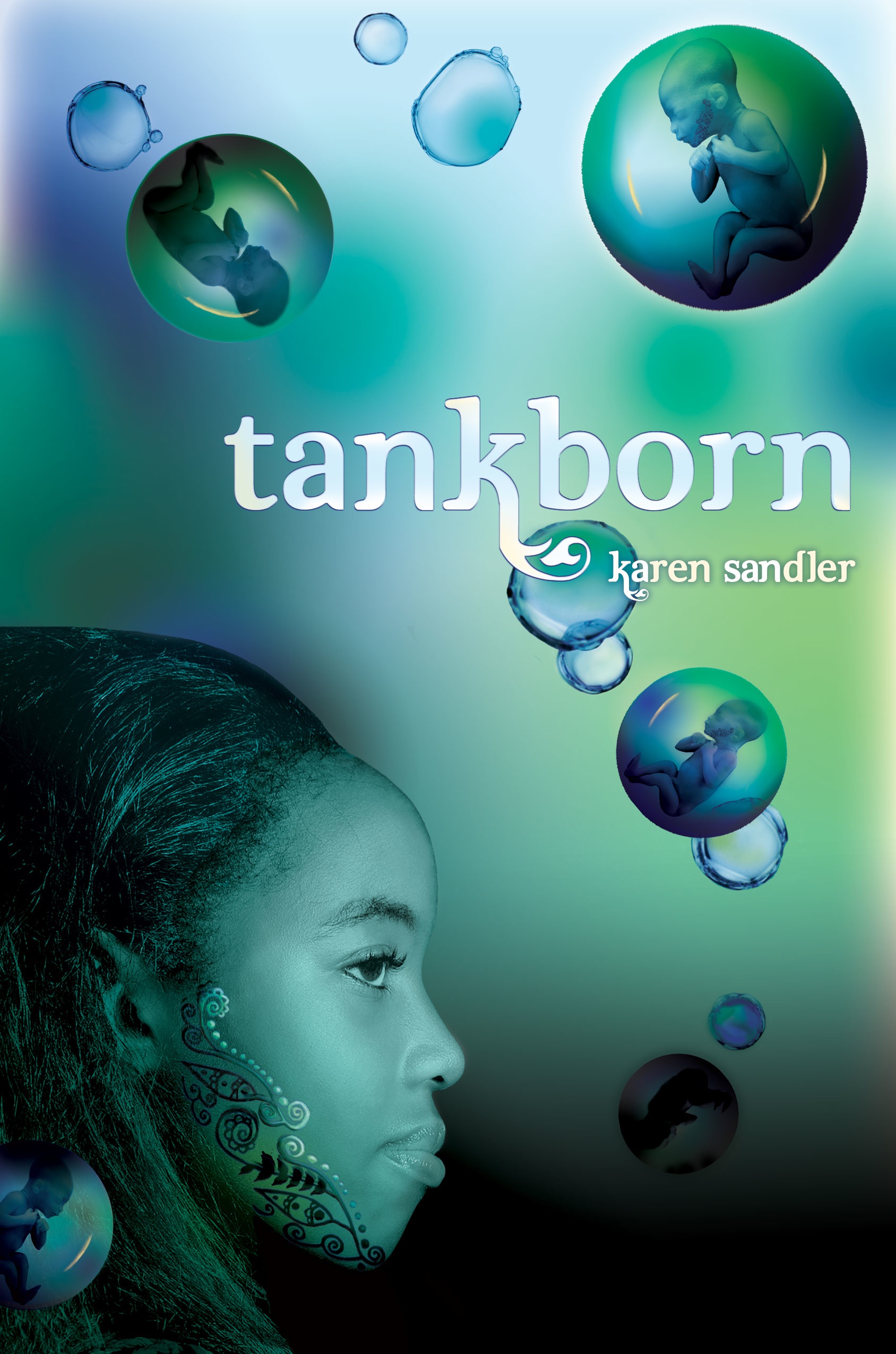
    Just a short post to announce that I can now reveal the cover art for TANKBORN, my dystopian young adult novel that will be coming out in September 2011 from Lee & Low’s new YA/MG imprint, Tu Books. Lee & Low announced the three launch books on their Open Books blog. You can check out the cover there, or hop on over to my website (where this blog also appears) for a slightly larger version. The blurb for the book is on my booklist page.

    I’m so excited about my cover. I think it looks great. There’s one kind of cool-creepy aspect to the image. If you look closely at it (you’ll have to examine the larger one that’s on my site) you’ll see the floating babies have tattoos on their cheeks that match the one on the heroine, Kayla’s, face. You’ll have to read the book to find out what that’s all about.

    So please check it out and tell me what you think!

  • When Japan is Right Next Door

    Let me say right at the outset that I hate earthquakes. They scare the crap out of me. Just my luck to grow up in Southern California, one of the earthquake capitals of the world.

    There are three in particular I remember. First, the San Fernando quake in 1971. My two older sisters and I were way underage, but one of them had hidden a bottle of booze in a dresser drawer. After the quake stopped, they both went running for the dresser, worried that the bottle might have broken.

    The Whittier Narrows quake in 1987 happened while I was driving, so I didn’t feel it. I do recall riding out an aftershock gripping my younger son’s crib while the house shook. No fun for me, but my husband thought it was cool. Crazy guy likes earthquakes.

    The Loma Prieta quake in 1989 was the worst of them all. No, that one wasn’t in Los Angeles. Its epicenter was up in the Bay Area. A double decker section of Interstate 880 collapsed, trapping hundreds. A section of the Bay Bridge also collapsed, although overall the damage wasn’t as bad as on I-880. Even so, I still get uneasy driving the Bay Bridge into San Francisco, not to mention the realization I’m driving into earthquake country.

    When we moved to Northern California (thankfully before the Northridge quake in 1994), we settled in a wonderfully seismically stable area. Yes, we contend with wildfires in the summer, but at least the earth doesn’t move.

    Japan is more than 5000 miles away from me. I’m well inland, so the tsunami that followed the earthquake had no impact on me. But I have a connection to Japan that makes the events there seem very personal. My older son lives in Osaka and teaches English there.

    That’s Eric on the left with his friends Yusuke and Kae. Living in Japan was a dream of Eric’s since junior high, but I admit I passed it off as one of those things kids think they want to do but gets cast by the wayside when they grow up. But he never gave up on that dream and worked very hard to make it come true. He spent the last year and a half attending a Japanese language school and now is staying one more year in Osaka to teach English.

    Skyping with him every week, hearing his stories of the neighborhood, seeing his pictures, hearing about the food he’s eaten and the temples he’s visited makes Japan seem much more real than just a country drawn on a map. We even stayed up until midnight one night so we could meet some of the people he works with and a couple of the kids he teaches. We spent most of the time on Skype laughing and smiling. It was clear they like my son very much.

    So when a terrible event like the earthquake and tsunami happens, it hits hard. Yes, I’m grateful my son is safe in Osaka. But my prayers are with everyone in Japan, to those affected by the earthquake, those who have lost loved ones, those working hard to save others. God’s blessings to them all.

    Click for the American Red Cross.