 Your regularly scheduled blog will return when The Denking Book is Done. And whoever stole my rewrite fairy wand had better return it NOW.
Meanwhile, a kitten to soothe you.


Your regularly scheduled blog will return when The Denking Book is Done. And whoever stole my rewrite fairy wand had better return it NOW.
Meanwhile, a kitten to soothe you.
Sometimes the passage of time between when a book is contracted and when it’s finally launched into the brave new world seems like forever. But finally it’s the official release day for Tu Books’ spring 2013 releases. The first one is mine, the second by fellow Tu Books author Shana Mlawski.
Awakening by Karen Sandler, Book 2 of the Tankborn trilogy
Once a Chadi sector GEN girl terrified of her first Assignment, Kayla is now a member of the Kinship, a secret organization of GENs, lowborns, and trueborns. Kayla travels on Kinship business, collecting information to further the cause of GEN freedom.
Despite Kayla’s relative freedom, she is still a slave to the trueborn ruling class. She rarely sees trueborn Devak, and any relationship between them is still strictly forbidden.
Kayla longs to be truly free, but other priorities have gotten in the way. A paradoxically deadly new virus has swept through GEN sectors—a disease only GENs catch. And GEN warrens and warehouses are being bombed, with only a scrawled clue: F.H.E. Freedom, Humanity, Equality.
With the virus and the bombings decimating the GEN community, freedom and love are put on the back burner as Kayla and her friends find a way to stop the killing . . . before it’s too late.
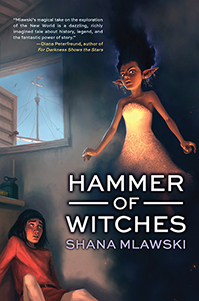 Hammer of Witches by Shana Mlawski
Baltasar Infante, a bookmaker’s apprentice living in 1492 Spain, can weasel out of any problem with a good story. But when he awakes one night to find a monster straight out of the stories peering at him through his window, he’s in trouble that even he can’t talk his way out of.
Soon Baltasar is captured by a mysterious arm of the Spanish Inquisition, the Malleus Maleficarum, that demands he reveal the whereabouts of Amir al-Katib, a legendary Moorish sorcerer who can bring myths and the creatures within them to life. Baltasar doesn’t know where the man is—or that he himself has the power to summon genies and golems.
Baltasar must escape, find al-Katib, and defeat a dreadful power that may destroy the world. As Baltasar’s journey takes him into uncharted lands on Columbus’s voyage westward, he learns that stories are more powerful than he once believed them to be—and much more dangerous.
I hope you’ll check them both out!
 Back in my romance writing days, I didn’t write trilogies. The love stories I wrote were one-offs. Although half of my Harlequin books (Counting on a Cowboy, A Father’s Sacrifice, His Baby to Love, The Three-Way Miracle, and Her Baby’s Hero) were all set in the same small town of Hart Valley and had some overlapping characters, there weren’t any connections between the stories. There were two books I did for Harlequin (Their Second-Chance Child and The Family He Wanted) that were part of the Fostering Family mini-series, where the second book picked up where the first left off. Characters from the first book were mentioned in the second, but the main story revolved around a new hero and heroine.
 Then along came Tankborn. When I first wrote Tankborn, I had a hazy idea of possibly writing a trilogy. Then when I signed with my agents and we were getting the manuscript ready for submission, they suggested I write up short blurbs for a second and third book. When we sold to Lee and Low/Tu Books, the original contract was only for the one book, but we later sold them two other books to complete the trilogy.
So my foray into writing my first real trilogy actually commenced with the second Tankborn book. With book one, I was blissfully ignorant of how anything I wrote might have a ripple effect into books two and three. Although I’d still had that hazy idea of writing two more books, I completed Tankborn and saw it into print before I ever wrote word one of the second book, Awakening.
And that was when the hand-shackles went on. From the moment I started Awakening, I had to constantly keep in mind the Tankborn universe. The book was already printed, many, many people had already read it, and while most readers probably wouldn’t notice if some little detail wasn’t consistent, someone somewhere would.
So I certainly couldn’t change the planet my characters were on from Loka to somewhere else. I could not make the sky blue instead of green. There had to be two suns in the sky, not one. And seycats and droms had to have six legs, not four or eight. In other words, I couldn’t fudge or goof. The first book was already in print, there for anyone to refer to and point out my mistakes.
Still, as I wrote Awakening, I thought it was pretty cool having the Tankborn universe already defined. I didn’t have to re-invent the wheel. If I couldn’t remember whether seycats had stripes or spots, or just how tall a genetically engineered drom was, I had the best reference in the world–the first book.
So I finished Awakening feeling pretty good about things. My editor and I had a great round of developmental edits that strengthened all my characters and added some complexity to the plot. Then it was time for the copy editor.
That’s when the oopsies started. For instance, Risa, a very minor character in Tankborn, is a prominent secondary character throughout Awakening. As I fleshed out her character in the second book, I gave her red hair mixed with gray. I didn’t bother to check in Tankborn to see if I’d mentioned what color hair Risa had. But the copy editor did check. And pointed out that in Tankborn, Risa is described as having dark hair. For continuity’s sake, Risa’s hair couldn’t be red.
 This may seem very minor (and it was for the most part). But I was a little sad at the necessity because Risa has a pet seycat (a wild feline indigenous to the planet Loka) and seycat coats are red (with black/grayish markings). I’d really liked the idea that Risa’s hair matched the seycat’s. That had to go away with the change of hair color, which required a bit more tweaking than a simple change from red to dark.
The second blooper was an incorrect character name. There’s an important character who plays a very minor role in Tankborn, a slightly more important role in Awakening, and will play a major role in the third book of the trilogy, Revolution. I used the wrong name for her throughout Awakening. I hadn’t remembered that one of the last changes we made in Tankborn before it went to print was to change that character’s name. Again, it was a good catch on the part of the copy editor that saved us from using the wrong name and really confusing readers.
 Alas, there is an error/inconsistency that was my fault that sneaked its way into Tankborn. I only noticed it as I was working on Revolution. There’s a shrub on the planet Loka called a sticker bush. At least that’s what I was calling it all through Awakening, what I thought I’d called it in Tankborn. But it turns out that at some point, I decided to call the sticker bush a prickle bush instead. And I wasn’t even consistent at that, because while I call it a prickle bush twice in Tankborn, I call it a sticker bush once.
So what to do? Prickle or sticker? I realized I liked sticker bush better and made an executive decision to call it that, inconsistency be damned.
Live and learn. Continuity in trilogies has proved to be a tricky business. I’ll have another chance to play around with this in my upcoming mystery series from Angry Robot/Exhibit A, which begins with Clean Burn. Since it’s not science fiction, it should be a piece of cake, right?
Right.
This week, YA Highway’s Road Trip Wednesday offers up the blog prompt What is it that makes some books ideal for a film translation? I feel a little like that kid in class whose teacher finally asks a question she knows the answer to. The kid who suddenly wakes up and waves her arm, praying the teacher will call on her.
Well, okay, I’m not that much of an expert on books being adapted into movies. But I have written a half-dozen or so screenplays and have written and produced a few short films. My book Tankborn and its sequels Awakening and Revolution were all adapted from a film script to books (so I’m hoping they can some day go the other way too). So I’ve actually thought a lot about what kind of books make good movies.
IMHO, the one quality that makes a book most adaptable into film is a high concept premise. What’s high concept? I define it as a premise that can easily be described in one sentence. I’ve also heard it defined as a premise for which you can immediately imagine its movie poster. Hunger Games is an excellent example. In the future, teens are chosen in a lottery for a fight to the death with other teens. Jurassic Park–scientists recreate dinosaurs using DNA and the dinosaurs fight back. I think Scott Westerfeld’s Uglies books, in which “ugly” children are converted to “pretties” at age 16, but there’s something rotten at the core of the process, is pretty high concept and would make a fantastic film franchise.
But not every movie is high concept, nor is every book that’s adapted to film high concept. Another crucial quality is that the book is very visual. There’s plenty of action on the page as opposed to lots of internal dialogue or long descriptive passages. There’s a whole lot of the novel Pride and Prejudice that’s left out of the movie because it just doesn’t translate into the visual medium of film.
A third quality of a filmable book is that its story already follows a three act structure. I bet if you analyzed the movies you’ve seen, you’ll see the three act structure in most of them.
What does that structure look like? The first act sets up the characters and their story dilemma, then there’s an inciting incident at the end of the first act that sets the hero/heroine on his/her way to their goal. The stakes continually rise in the second act, and there will be a turning point in the middle that changes everything, then a dark moment at the end of the second act. Then there’s the third act’s climax and denouement.
Think about some of the books you’ve read, and I’ll bet many of them use this three act structure. Maybe the author made a conscious decision to write their book that way, or maybe the book ended up with three act structure because it’s a great way to write a story.
So think about your own book, or if you’re not a writer, think about a fiction book you’ve recently read. Is it high concept (can you describe it in one sentence)? Is it extremely visual? Is it already written in a three act structure? Then you might have a very film adaptable story. I hope Hollywood comes knocking.
 When does dialogue constitute a scene? If two or more characters are talking to one another about elements of the story they’re featured in, is that a scene? And if it is a scene, how much of it can we include on the page without interspersing it with action?
To me, a scene is where something is happening. It’s a visual depiction of that something. It must be pertinent to the story and move it forward, but if there’s something important to your story, I fervently believe it should be shown and not talked about.
Of course, dialogue does have its place. I recall learning (back in the Dark Ages when I first started writing) three rules about dialogue. Dialogue should do one or more of the following:
So, yes, you could have some number of characters in a room talking, characterizing themselves with their word choices or tone (e.g., using plenty of slang & f-bombs, or more erudite language), revealing information (e.g., that they saw Col. Mustard in the library with a hammer), and moving the story forward (e.g., I’m pregnant, and you’re the father). But if it’s just folks talking in a room, is that really the best way to use dialogue?
The issue is really how much of your book is dialogue in a static place and how much is action that either leads into that dialogue, or action that follows that dialogue. If your story is fast-paced, with your characters constantly in peril, it’s great to have scenes in which they can take a breather, to sit together and just talk and regroup. James Rollins Map of Bones is a good example of that. Rollins places his characters in one dire situation after another, but there are revelations that they have to have time to chew over. So they get to safety and work out what those revelations mean, providing the reader with information, characterizing the characters, and moving the story forward.
Here’s a dialogue example from my book, Tankborn. I’ve taken most of the action out of the exchange between Kayla and her nurture brother, Jal:
“Tala’s out,” Jal said, “cleaning Spil and Zeva’s flat.”
“Then we have time to change and get the river sludge out of our clothes.”
“What about this?”
“I’ll doctor it. If she asks, you slipped climbing down the riverbank.”
“If she’s tired enough,” Jal pointed out, “she might not even
notice the scratch.”
“She’ll notice. She just might not have the energy to push it.”
“Tala shouldn’t have to work so hard.”
“You volunteering to stop eating? We could save plenty of dhans not paying for the kel-grain you inhale.”
“I mean, the trueborns should give her a new baby so she won’t have to clean flats.”
As written above, it’s not really a scene at all. It’s just two talking heads. Here’s the same excerpt with the action included:
When Kayla slipped into the twenty-ninth warren, Jal was waiting for her by the stairs. “Tala’s out,” Jal said, “cleaning Spil and Zeva’s flat.”
Kayla brushed past Jal and up the stairs. “Then we have time to change and get the river sludge out of our clothes.”
“What about this?” Jal tapped the scratch on his cheek.
“I’ll doctor it. If she asks, you slipped climbing down the riverbank.”
“If she’s tired enough,” Jal pointed out, “she might not even notice the scratch.”
“She’ll notice. She just might not have the energy to push it.”
Jal crowded up past Kayla and walked backward up the stairs. “Tala shouldn’t have to work so hard.”
Kayla slanted a look up at him. “You volunteering to stop eating? We could save plenty of dhans not paying for the kel-grain you inhale.”
Jal gave Kayla a poke. “I mean, the trueborns should give her a new baby so she won’t have to clean flats.”
With the interspersed action, the dialogue becomes a scene. Not so much a whizbang high-action scene, but we get a sense of place, and a sense of the relationship between Kayla and Jal, as well as revealing information about their nurture mother, Tala.
If you’re a writer, how do you handle dialogue to avoid the dreaded Talking Heads Syndrome? If you’re a reader, what do you think of dialogue that’s independent from action? I’d love to hear others’ opinions.